The Exquisite Corpse
Singapore and the Occult Trade
Singapore is known as the law-and-order jewel of Asia. But scratch the surface and you'll find a culture of superstition, corpse oils, talisman shops, & black magicians who will curse your enemies.
And that’s just the beginning.
When I landed in Singapore for the first time, my top priority was to hit the Long Bar in the Raffles Hotel and order a Singapore Sling.
The hotel is an institution of the Lion City. Founded in 1887 by the Armenian Sarkies brothers and named after Singapore’s founder, Sir Stamford Raffles, the hotel has kept its allure for over 130 years.
Its colonial architecture, impeccable service, and roster of legendary guests - Kipling, Conrad, Chaplin - are only trumped, in my mind, by the fact that this gin sling was first crafted there in 1915. Others may be impressed that Murakami wrote a novel named after the hotel, but for me, the drink is what pulled me in.
The hotel sits a stone’s throw from Singapore’s central business district on Beach Road. The street is lined with other prominent city landmarks, like the neo-gothic St Andrew’s Cathedral; and the Masjid Hajjah Fatimah mosque, itself an architectural marriage of European and Islamic style. Another symbol of the eclectic city.
When you arrive to the Raffles, a tall Sikh man wearing a white, neatly tailored old-fashioned military suit will greet you. His employment is a holdover from the lost colonial era.
The bar will be packed, so go early.
On this first trip to Singapore a decade ago, I sipped the lush, sunset-colored sling at the Long Bar and thought of the legends who had sat on the same stools before me.
I felt like I had made it. I was just a dropout 20-something kid from Nowhere, America - and here I was in a tropical dream, at a bar in a hotel that I couldn’t afford to stay at, surrounded by expat old hands and stunning Asian women splashing cash.
My friends were back drinking Pabst tappers at the corner bar playing the same tired jukebox tunes and passing around the same barflies - no bueno.
I knew Asia was the place for me.
My interest in Asia wasn’t this superficial, however.
I first picked up a book on vipassana meditation written by a monk from the Thai Forest Tradition when I was 15, and after that turned to an autodidact study of the Pali Suttas.
It was this strain of my soul, the one tied up in eastern mysticism - which some of you would consider as a polluted superstition, but for me it is of great importance - that brought me to Asia in the first place.
And during my visit to Singapore, this interest sent me around the city to examine its Buddhist shrines.
Two of the great schools of Buddhism, what we classify as Theravada and Mahayana, are represented in the Lion City, as the population is a mix of East, South, and Southeast Asian. So there are no shortage of temples that you can visit, and I did, ticking off the major ones on my route.
But one morning something else caught my eye.
It was a small shop house tucked in an alley just outside the central district. The signage was in gold Chinese characters, but underneath in red lettering it said: Amulets, Magic, & Fortune.
I stepped in and the old uncle shopkeeper ignored me. The shelves were dusty and disheveled, filled with amulets of the Buddha, different monks, and other deities, along with small bottles of oils, joss sticks, statues, coins, and flowers.
One item stood out, sitting in the dim corner: a child’s doll that was tattooed with sak yant, Thai magical symbols and lettering. Later I learned this doll was known as a kuman thong (กุมารทอง in Thai), a “golden child”.
I studied the doll until I felt the old uncle’s eyes tracking me. The longer I lingered, the heavier his gaze felt.
I was fairly new to Asia at this time, and out of respect, I took leave of the shop and walked back to my hotel - a cheap 2-star flop - to research more, as that strange tattooed doll wouldn’t leave my mind.
I discovered that Singapore had many of these amulet shops, with one of the busiest centers at the Fu Lu Shou Complex, a mixed indoor-outdoor mall just a ten-minute walk from the Raffles. Quite literally in the hotel’s opulent shadow.
I spent the next afternoon in the bustle of Fu Lu Shou and its maze of shops. The irony that on the surface this city-state was modern, regimented, and wealthy, but possessed an underbelly of superstition intrigued me.
This is what inspired the research for this essay.
After returning to Thailand, and over the years, I met several individuals who told me more about the occult trade that the Singaporeans were fervently devoted to.
And it’s at this point where I move beyond my anecdotes and into into the side alleys of Singapore’s underground magic economy, introduce its practitioners, their relics and history, in this essay that I call: The Exquisite Corpse
Hoary Origins
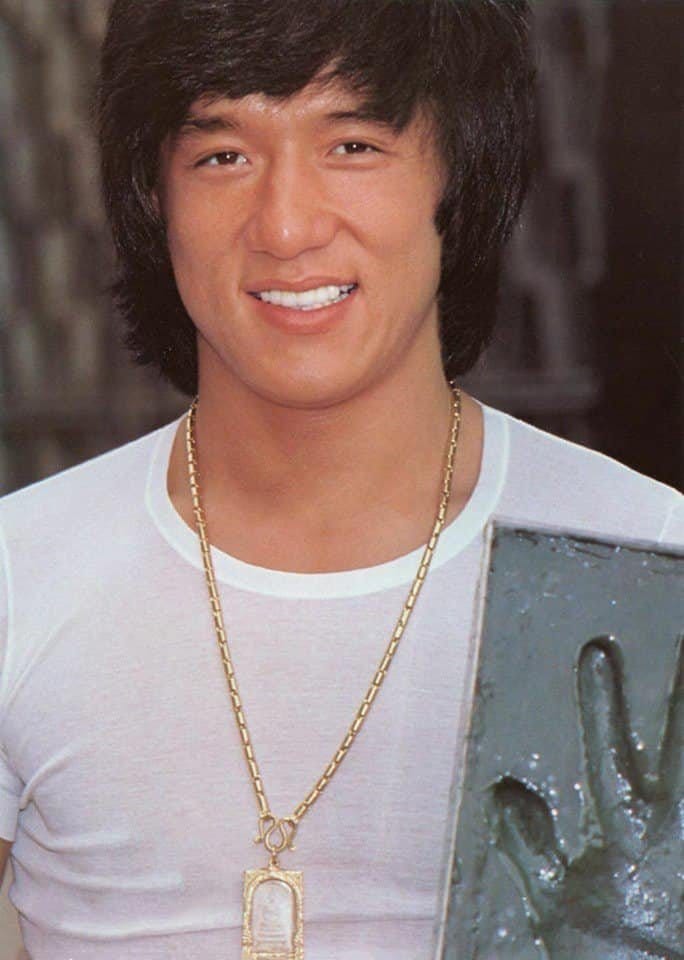 The handsome Jackie Chan, 1974
Many trace Singapore’s interest in Thai Buddhist occultism to an unlikely source: Jackie Chan. In 1974, audiences in Hong Kong, Taiwan, and Singapore saw Jackie Chan wearing this Thai amulet.
The specific amulet in this photo was produced at Wat Phikunthong, a temple about 90 minutes from Bangkok, by the revered abbot Luang Phor Pae.
He was famous for his amulet productions in the 20th century. The image of the amulet is of one Somdej Toh (สมเด็จโต), a master of Thai Buddhism, who lived and taught the Dhamma in the early-to-mid 19th century.
After Chan was seen wearing it, demand for Phra Somdej amulets surged across SE Asia and beyond.
Here is an advertisement from 1986 that shows this phenomenon.
And a contemporary online advertisement, which shows that this specific version of the Phra Somdej, sourced from Luang Phor Pae, still has considerable commercial interest:
But the interest in Thai amulets goes further back still.
There was another famous monk, called Luang Por Kron by Thais and Tok Raja by Malaysians and Singaporeans, a title reserved for Sultans of the Malay. He had the face of a bulldog and lived in the Malaysian state of Kelantan, which borders southern Thailand.
He started producing Phra Pidta (พระปิดตา in Thai), or “blind-folded Buddha” amulets in 1957. They were made from the sap of the Ton Rak tree (ต้นรัก in Thai, scientific name Gluta usitata) - prized for a source of lacquer in that country. Chinese Singaporeans made pilgrimages to his temple at Kelantan, Wat Bang Sae, and a brisk trade in his creations still continues to this day.
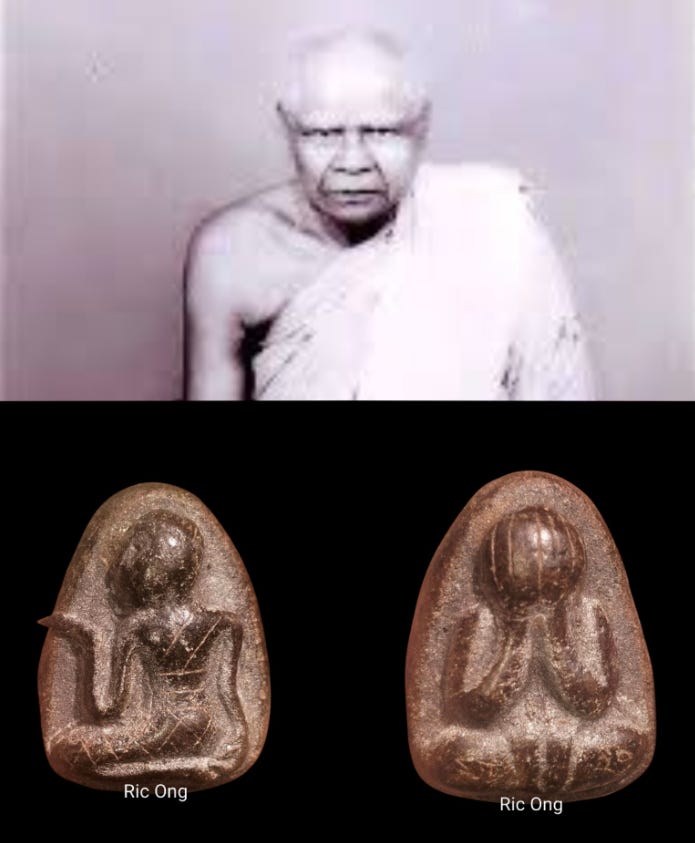 Luang Por Kron, the bulldog-faced master
This is all to say that pilgrimage to Thai temples for occult protection has long been common among Chinese Malaysians and Singaporeans.
Scholars trace Chinese interest in Thai magic back to the British Malaya period.
But it wasn’t until the post-independence era, starting in 1957, when popular interest really took hold. Change and uncertainty ruled this time, while Chinese-Singaporeans turned to amulets for spiritual protection.
There are dozens of monasteries and sacred sites across the Islamic-dominant border provinces of Songkhla and Pattani on the Thai side and Kelantan on the Malay, where monks steeped in the esoteric tradition of these amulets live and work. It’s easy to catch a bus from Singapore to this border region, costing about $40 USD and taking 14 hours.
And remember: these buses go both ways. Singapore hosts between 20,000 - 50,000 Thai guest workers, who bring their culture and customs with them, which includes an unflinching belief in ghosts, curses, amulets, magical objects, and the rituals that can bring merit, and misfortune, to their desired targets.
You may wonder why Buddhists would put their faith in amulets.
It’s not my intention to write the complete history of magic and occultism in Buddhist cultures, since that would be beyond the scope of this piece, but it’s crucial that a background to these practices are given here.
In the Kevatta Sutta of the Digha Nikaya, the Buddha lays out the various iddhis (Pali; ‘siddhis’ in Sanskrit) that his followers may encounter.
He describes a monk who can bi-locate; appear and disappear; move through walls and mountains; dive into the earth as if it was water; walk on water as if it were land; fly like a bird while sitting. He can access these powers through a “Gandhari charm,” or the power of concentrated will itself.
There’s another charm, the “Manika,” that grants power to read minds.
But the Buddha dismissed these miracles as distractions, saying he felt “horrified, humiliated, and disgusted” by them. They’re byproducts of spiritual practice, but ultimately don’t resolve the main problem that he identifies in life - that of suffering (dukkha) or its solution, which are the Four Noble Truths (cattari ariyasaccani, Pali).

The mythic bull-head lersi of the forest
This is one reason why many, even in countries like Thailand, Burma, and Cambodia where amulet culture is strong, see the belief in these powers as adharmic or against the teachings of Gotama Buddha.
And yet, things remain complicated.
In Thailand, the figure of the wandering forest sage, the Ruesi / lersi (in Thai, ฤๅษี; rishi in Sanskrit; “seer” in English) dominates the popular consciousness - although there are less than 100 real ones left in the country.
In iconography he shows up as a man of nature, a chimera with a demon or lion or bull’s head, or wearing the skin of tigers, uncut hair, and sitting in meditative positions. Rare photo of Lersi Tafai Akhadamo, with two female disciples
In Burma, they call this man the weizza (ဝိဇ္ဇာ, Burmese; from the Sanskrit vidyadhara; sharing the same proto-Indo-European root, *weyd-, meaning “to see”, as English’s wizard).

Rare photo of Lersi Tafai Akhadamo, with two female disciples
The wiezza are organized in secret groups who work with various forms of magic - alchemy, incantations, metallurgy, and forest medicine - and they’re documented in texts that are over 2,000 years old.
Much of Thai magic was transmitted into the culture from India through Burma over the centuries, then later spread into Cambodia and beyond.
This is the tradition that produced what we see in modern amulets, yantra and sak yant (magical tattoos), and other magical relics found in SE Asia.
It’s here that I want to introduce the specifics of how this occult economy works, who are the procurers, producers, and smugglers that bring these items into Singapore.
And since we’ve briefly explored the history, let’s look at a few of the rarest items that Singaporeans seek, the ones that fetch the highest prices.
This is where things get a little strange.